•  

US: North Dakota Sees Powerful Winds Amid Tornado-Producing Storm

Severe weather swept across the upper Midwest on Friday, June 20, bringing powerful winds and leaving at least 3 dead in North Dakota as a tornado ripped through the area.

  •  
CHINA-CHENGDU-FRANCE-MONTPELLIER-FRIENDSHIP (CN)

CHINA-CHENGDU-FRANCE-MONTPELLIER-FRIENDSHIP (CN)

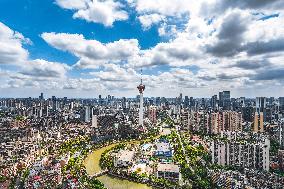
(230721) -- BEIJING, July 21, 2023 (Xinhua) -- This aerial photo taken on April 20, 2021 shows the Panda Tower in Chengdu, southwest China's Sichuan Province. The Chengdu Universiade is just around the corner, and college athletes from all over the world will gather in Chengdu to strive for their dreams. Chengdu has many sister cities around the world. In 1981, Chengdu and Montpellier of France became the first pair of sister cities of the two countries. In 2011, the Montpellier Chengdu Primary School and the Chengdu Montpellier Primary School were built in Montpellier and Chengdu respectively to mark the 30th anniversary of the establishment of sister cities relationship between the two cities. (Photo by Zhang Xiangsheng/Xinhua)

  •  
CHINA-JIANGXI-JINGDEZHEN-SWEDISH ARTIST (CN)

CHINA-JIANGXI-JINGDEZHEN-SWEDISH ARTIST (CN)

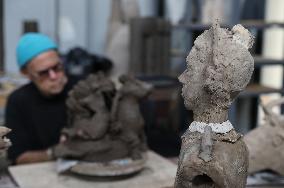
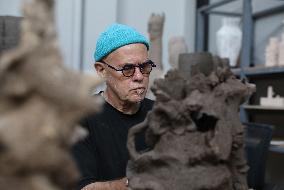
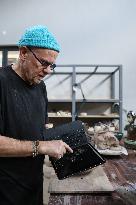
(230425) -- JINGDEZHEN, April 25, 2023 (Xinhua) -- Torsten Jurell works in his studio at the Taoxichuan ceramic art avenue in Jingdezhen, east China's Jiangxi Province, April 20, 2023. Swedish artist Torsten Jurell came to Jingdezhen, a world-famous "porcelain capital", in 2011 for the first time where he embarked on a new journey of art. Torsten Jurell's interest in China came from his father, an enthusiast in restoring Chinese porcelain. Torsten Jurell found Chinese porcelain a beautiful and special form of art since his childhood. Now he spends a few months in this city almost every year and gets in touch with many ceramists and traditional artisans here. Torsten Jurell works in various fields such as printmaking, ceramics and sculpture. In Jingdezhen, he tries to draw inspiration in Chinese mythology. "Jingdezhen is like a universe with infinite space for creativity and imagination. I hope to bring more people here to get to know local life and culture and feel the open and diverse artistic atmosphere,"

  •  
CHINA-JIANGXI-JINGDEZHEN-SWEDISH ARTIST (CN)

CHINA-JIANGXI-JINGDEZHEN-SWEDISH ARTIST (CN)

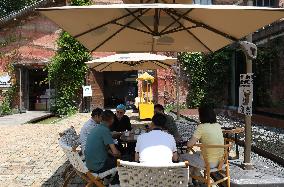
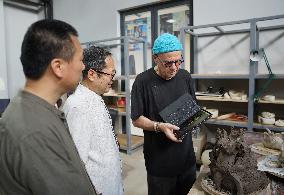
(230425) -- JINGDEZHEN, April 25, 2023 (Xinhua) -- Torsten Jurell (3rd, L) talks with his friends at the Taoxichuan ceramic art avenue in Jingdezhen, east China's Jiangxi Province, April 20, 2023. Swedish artist Torsten Jurell came to Jingdezhen, a world-famous "porcelain capital", in 2011 for the first time where he embarked on a new journey of art. Torsten Jurell's interest in China came from his father, an enthusiast in restoring Chinese porcelain. Torsten Jurell found Chinese porcelain a beautiful and special form of art since his childhood. Now he spends a few months in this city almost every year and gets in touch with many ceramists and traditional artisans here. Torsten Jurell works in various fields such as printmaking, ceramics and sculpture. In Jingdezhen, he tries to draw inspiration in Chinese mythology. "Jingdezhen is like a universe with infinite space for creativity and imagination. I hope to bring more people here to get to know local life and culture and feel the open and diverse artistic a

  •  
CHINA-JIANGXI-JINGDEZHEN-SWEDISH ARTIST (CN)

CHINA-JIANGXI-JINGDEZHEN-SWEDISH ARTIST (CN)

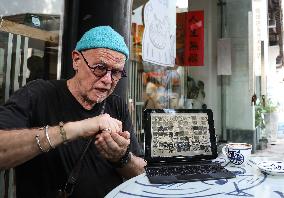
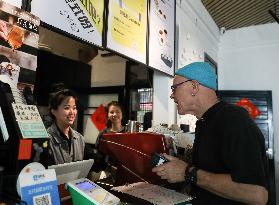
(230425) -- JINGDEZHEN, April 25, 2023 (Xinhua) -- This photo taken on April 20, 2023 shows Torsten Jurell at a cafe in Jingdezhen, east China's Jiangxi Province. Swedish artist Torsten Jurell came to Jingdezhen, a world-famous "porcelain capital", in 2011 for the first time where he embarked on a new journey of art. Torsten Jurell's interest in China came from his father, an enthusiast in restoring Chinese porcelain. Torsten Jurell found Chinese porcelain a beautiful and special form of art since his childhood. Now he spends a few months in this city almost every year and gets in touch with many ceramists and traditional artisans here. Torsten Jurell works in various fields such as printmaking, ceramics and sculpture. In Jingdezhen, he tries to draw inspiration in Chinese mythology. "Jingdezhen is like a universe with infinite space for creativity and imagination. I hope to bring more people here to get to know local life and culture and feel the open and diverse artistic atmosphere," said Torsten Jurell. (

  •  
CHINA-JIANGXI-JINGDEZHEN-SWEDISH ARTIST (CN)

CHINA-JIANGXI-JINGDEZHEN-SWEDISH ARTIST (CN)

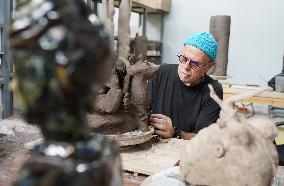
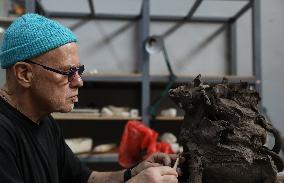
(230425) -- JINGDEZHEN, April 25, 2023 (Xinhua) -- Torsten Jurell observes an unfinished creation in his studio at the Taoxichuan ceramic art avenue in Jingdezhen, east China's Jiangxi Province, April 20, 2023. Swedish artist Torsten Jurell came to Jingdezhen, a world-famous "porcelain capital", in 2011 for the first time where he embarked on a new journey of art. Torsten Jurell's interest in China came from his father, an enthusiast in restoring Chinese porcelain. Torsten Jurell found Chinese porcelain a beautiful and special form of art since his childhood. Now he spends a few months in this city almost every year and gets in touch with many ceramists and traditional artisans here. Torsten Jurell works in various fields such as printmaking, ceramics and sculpture. In Jingdezhen, he tries to draw inspiration in Chinese mythology. "Jingdezhen is like a universe with infinite space for creativity and imagination. I hope to bring more people here to get to know local life and culture and feel the open and dive

  •  
CHINA-JIANGXI-JINGDEZHEN-SWEDISH ARTIST (CN)

CHINA-JIANGXI-JINGDEZHEN-SWEDISH ARTIST (CN)

(230425) -- JINGDEZHEN, April 25, 2023 (Xinhua) -- Torsten Jurell works in his studio at the Taoxichuan ceramic art avenue in Jingdezhen, east China's Jiangxi Province, April 20, 2023. Swedish artist Torsten Jurell came to Jingdezhen, a world-famous "porcelain capital", in 2011 for the first time where he embarked on a new journey of art. Torsten Jurell's interest in China came from his father, an enthusiast in restoring Chinese porcelain. Torsten Jurell found Chinese porcelain a beautiful and special form of art since his childhood. Now he spends a few months in this city almost every year and gets in touch with many ceramists and traditional artisans here. Torsten Jurell works in various fields such as printmaking, ceramics and sculpture. In Jingdezhen, he tries to draw inspiration in Chinese mythology. "Jingdezhen is like a universe with infinite space for creativity and imagination. I hope to bring more people here to get to know local life and culture and feel the open and diverse artistic atmosphere,"

  •  
CHINA-JIANGXI-JINGDEZHEN-SWEDISH ARTIST (CN)

CHINA-JIANGXI-JINGDEZHEN-SWEDISH ARTIST (CN)

(230425) -- JINGDEZHEN, April 25, 2023 (Xinhua) -- Torsten Jurell works in his studio at the Taoxichuan ceramic art avenue in Jingdezhen, east China's Jiangxi Province, April 20, 2023. Swedish artist Torsten Jurell came to Jingdezhen, a world-famous "porcelain capital", in 2011 for the first time where he embarked on a new journey of art. Torsten Jurell's interest in China came from his father, an enthusiast in restoring Chinese porcelain. Torsten Jurell found Chinese porcelain a beautiful and special form of art since his childhood. Now he spends a few months in this city almost every year and gets in touch with many ceramists and traditional artisans here. Torsten Jurell works in various fields such as printmaking, ceramics and sculpture. In Jingdezhen, he tries to draw inspiration in Chinese mythology. "Jingdezhen is like a universe with infinite space for creativity and imagination. I hope to bring more people here to get to know local life and culture and feel the open and diverse artistic atmosphere,"

  •  
CHINA-JIANGXI-JINGDEZHEN-SWEDISH ARTIST (CN)

CHINA-JIANGXI-JINGDEZHEN-SWEDISH ARTIST (CN)

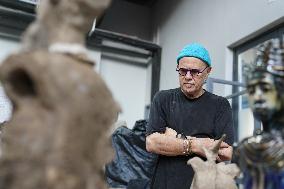
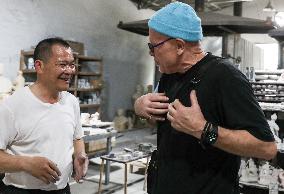
(230425) -- JINGDEZHEN, April 25, 2023 (Xinhua) -- Torsten Jurell (R) talks with an employee of a sculptural porcelain factory in Jingdezhen, east China's Jiangxi Province, April 20, 2023. Swedish artist Torsten Jurell came to Jingdezhen, a world-famous "porcelain capital", in 2011 for the first time where he embarked on a new journey of art. Torsten Jurell's interest in China came from his father, an enthusiast in restoring Chinese porcelain. Torsten Jurell found Chinese porcelain a beautiful and special form of art since his childhood. Now he spends a few months in this city almost every year and gets in touch with many ceramists and traditional artisans here. Torsten Jurell works in various fields such as printmaking, ceramics and sculpture. In Jingdezhen, he tries to draw inspiration in Chinese mythology. "Jingdezhen is like a universe with infinite space for creativity and imagination. I hope to bring more people here to get to know local life and culture and feel the open and diverse artistic atmospher

  •  
CHINA-JIANGXI-JINGDEZHEN-SWEDISH ARTIST (CN)

CHINA-JIANGXI-JINGDEZHEN-SWEDISH ARTIST (CN)

(230425) -- JINGDEZHEN, April 25, 2023 (Xinhua) -- Torsten Jurell (1st, R) talks with his friends in his studio at the Taoxichuan ceramic art avenue in Jingdezhen, east China's Jiangxi Province, April 20, 2023. Swedish artist Torsten Jurell came to Jingdezhen, a world-famous "porcelain capital", in 2011 for the first time where he embarked on a new journey of art. Torsten Jurell's interest in China came from his father, an enthusiast in restoring Chinese porcelain. Torsten Jurell found Chinese porcelain a beautiful and special form of art since his childhood. Now he spends a few months in this city almost every year and gets in touch with many ceramists and traditional artisans here. Torsten Jurell works in various fields such as printmaking, ceramics and sculpture. In Jingdezhen, he tries to draw inspiration in Chinese mythology. "Jingdezhen is like a universe with infinite space for creativity and imagination. I hope to bring more people here to get to know local life and culture and feel the open and dive

  •  
CHINA-JIANGXI-JINGDEZHEN-SWEDISH ARTIST (CN)

CHINA-JIANGXI-JINGDEZHEN-SWEDISH ARTIST (CN)

(230425) -- JINGDEZHEN, April 25, 2023 (Xinhua) -- Torsten Jurell (R) makes an order at a cafe in Jingdezhen, east China's Jiangxi Province, April 20, 2023. Swedish artist Torsten Jurell came to Jingdezhen, a world-famous "porcelain capital", in 2011 for the first time where he embarked on a new journey of art. Torsten Jurell's interest in China came from his father, an enthusiast in restoring Chinese porcelain. Torsten Jurell found Chinese porcelain a beautiful and special form of art since his childhood. Now he spends a few months in this city almost every year and gets in touch with many ceramists and traditional artisans here. Torsten Jurell works in various fields such as printmaking, ceramics and sculpture. In Jingdezhen, he tries to draw inspiration in Chinese mythology. "Jingdezhen is like a universe with infinite space for creativity and imagination. I hope to bring more people here to get to know local life and culture and feel the open and diverse artistic atmosphere," said Torsten Jurell. (Xinhua

  •  
CHINA-JIANGXI-JINGDEZHEN-SWEDISH ARTIST (CN)

CHINA-JIANGXI-JINGDEZHEN-SWEDISH ARTIST (CN)

(230425) -- JINGDEZHEN, April 25, 2023 (Xinhua) -- Torsten Jurell introduces his works in his studio at the Taoxichuan ceramic art avenue in Jingdezhen, east China's Jiangxi Province, April 20, 2023. Swedish artist Torsten Jurell came to Jingdezhen, a world-famous "porcelain capital", in 2011 for the first time where he embarked on a new journey of art. Torsten Jurell's interest in China came from his father, an enthusiast in restoring Chinese porcelain. Torsten Jurell found Chinese porcelain a beautiful and special form of art since his childhood. Now he spends a few months in this city almost every year and gets in touch with many ceramists and traditional artisans here. Torsten Jurell works in various fields such as printmaking, ceramics and sculpture. In Jingdezhen, he tries to draw inspiration in Chinese mythology. "Jingdezhen is like a universe with infinite space for creativity and imagination. I hope to bring more people here to get to know local life and culture and feel the open and diverse artisti

  •  
CHINA-JIANGXI-JINGDEZHEN-SWEDISH ARTIST (CN)

CHINA-JIANGXI-JINGDEZHEN-SWEDISH ARTIST (CN)

(230425) -- JINGDEZHEN, April 25, 2023 (Xinhua) -- Torsten Jurell works in his studio at the Taoxichuan ceramic art avenue in Jingdezhen, east China's Jiangxi Province, April 20, 2023. Swedish artist Torsten Jurell came to Jingdezhen, a world-famous "porcelain capital", in 2011 for the first time where he embarked on a new journey of art. Torsten Jurell's interest in China came from his father, an enthusiast in restoring Chinese porcelain. Torsten Jurell found Chinese porcelain a beautiful and special form of art since his childhood. Now he spends a few months in this city almost every year and gets in touch with many ceramists and traditional artisans here. Torsten Jurell works in various fields such as printmaking, ceramics and sculpture. In Jingdezhen, he tries to draw inspiration in Chinese mythology. "Jingdezhen is like a universe with infinite space for creativity and imagination. I hope to bring more people here to get to know local life and culture and feel the open and diverse artistic atmosphere,"

  •  
CHINA-JIANGXI-JINGDEZHEN-SWEDISH ARTIST (CN)

CHINA-JIANGXI-JINGDEZHEN-SWEDISH ARTIST (CN)

(230425) -- JINGDEZHEN, April 25, 2023 (Xinhua) -- Torsten Jurell (R) observes a ceramist working in Jingdezhen, east China's Jiangxi Province, April 20, 2023. Swedish artist Torsten Jurell came to Jingdezhen, a world-famous "porcelain capital", in 2011 for the first time where he embarked on a new journey of art. Torsten Jurell's interest in China came from his father, an enthusiast in restoring Chinese porcelain. Torsten Jurell found Chinese porcelain a beautiful and special form of art since his childhood. Now he spends a few months in this city almost every year and gets in touch with many ceramists and traditional artisans here. Torsten Jurell works in various fields such as printmaking, ceramics and sculpture. In Jingdezhen, he tries to draw inspiration in Chinese mythology. "Jingdezhen is like a universe with infinite space for creativity and imagination. I hope to bring more people here to get to know local life and culture and feel the open and diverse artistic atmosphere," said Torsten Jurell. (Xin

  •  
Mascot Onokun mingles with fans in Higashi-matsushima

Mascot Onokun mingles with fans in Higashi-matsushima

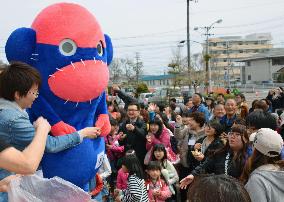
SENDAI, Japan - The mascot Onokun mingles with his ardent fans in Higashi-matsushima, Miyagi Prefecture, in northeastern Japan on April 20, 2014, commemorating the two-year anniversary of the birth of the character for craftwork in the form of a monkey made in the hope of the recovery of the 2011 disaster-hit city.

  •  
Fukushima students tour PM's office

Fukushima students tour PM's office

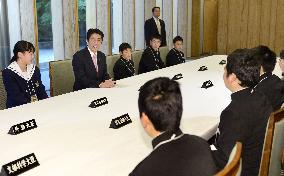
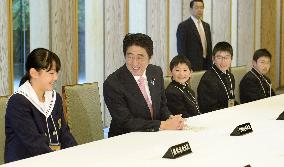
TOKYO, Japan - Prime Minister Shinzo Abe (facing, 2nd from L) talks with junior high school students from Minamisoma, Fukushima Prefecture, at the prime minister's office in Tokyo on April 20, 2013. Twelve students from the northeastern prefecture affected by the March 2011 earthquake and tsunami and ensuing nuclear disaster were invited on the tour by the prime minister's office and a nonprofit organization supporting children in the city.

  •  
Fukushima students tour PM's office

Fukushima students tour PM's office

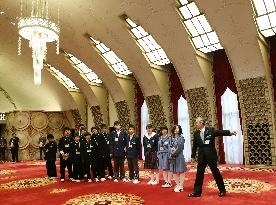
TOKYO, Japan - Junior high school students from Minamisoma, Fukushima Prefecture, take part in a special tour of the prime minister's official residence in Tokyo on April 20, 2013. The students from the northeastern prefecture affected by the March 2011 earthquake and tsunami and ensuing nuclear disaster were invited on the tour by the prime minister's office and a nonprofit organization supporting children in the city. (Pool photo)

  •  
Fukushima students tour PM's office

Fukushima students tour PM's office

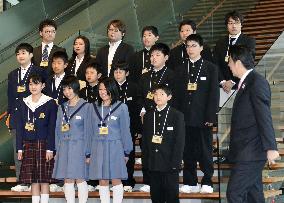
TOKYO, Japan - Prime Minister Shinzo Abe (far R) makes a surprise appearance while junior high school students from Minamisoma, Fukushima Prefecture, pose for photos at the prime minister's office in Tokyo on April 20, 2013. The students from the northeastern prefecture affected by the March 2011 earthquake and tsunami and ensuing nuclear disaster were invited on the tour by the prime minister's office and a nonprofit organization supporting children in the city.

  •  
Fukushima students tour PM's office

Fukushima students tour PM's office

TOKYO, Japan - Prime Minister Shinzo Abe (2nd from L) talks with junior high school students from Minamisoma, Fukushima Prefecture, at the prime minister's office in Tokyo on April 20, 2013. Twelve students from the northeastern prefecture affected by the March 2011 earthquake and tsunami and ensuing nuclear disaster were invited on the tour by the prime minister's office and a nonprofit organization supporting children in the city.

  •  
Abandoned animals in Fukushima

Abandoned animals in Fukushima

TOKYO, Japan - In this photo taken in the town of Tomioka, Fukushima Prefecture, on May 19, 2012, a cattle beast lies starved to death after its owner abandoned it in a barn. The town remains nearly deserted as the government in April 2011 designated it and other municipalities within a 20-kilometer ring around the crippled Fukushima Daiichi nuclear power plant as a no-go zone. The plant's reactors suffered meltdowns after being struck by the March 11, 2011, earthquake and tsunami, spewing massive amounts of radioactive materials into the air and sea.

  •  
Abandoned animals in Fukushima

Abandoned animals in Fukushima

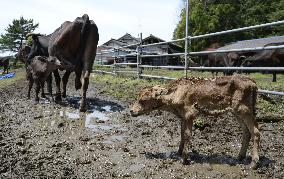
TOKYO, Japan - In this photo taken in the town of Tomioka, Fukushima Prefecture, on June 23, 2012, a calf (front) looks almost skeletal because its mother is too weak to breastfeed it. The town remains nearly deserted as the government in April 2011 designated it and other municipalities within a 20-kilometer ring around the crippled Fukushima Daiichi nuclear power plant as a no-go zone. The plant's reactors suffered meltdowns after being struck by the March 11, 2011, earthquake and tsunami, spewing massive amounts of radioactive materials into the air and sea.

  •  
Man caring for abandoned cattle in Fukushima

Man caring for abandoned cattle in Fukushima

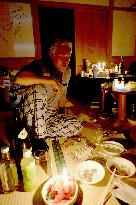
TOKYO, Japan - In this photo taken in the town of Tomioka, Fukushima Prefecture, on June 23, 2012, Naoto Matsumura, who cares for cattle abandoned by their owners, relaxes at his home after finishing his day's work of tending to pets and livestock. Without electricity, he relies on candles to light his room. The town remains nearly deserted as the government in April 2011 designated it and other municipalities within a 20-kilometer ring around the crippled Fukushima Daiichi nuclear power plant as a no-go zone. The plant's reactors suffered meltdowns after being struck by the March 11, 2011, earthquake and tsunami, spewing massive amounts of radioactive materials into the air and sea.

  •  
Abandoned animals in Fukushima

Abandoned animals in Fukushima

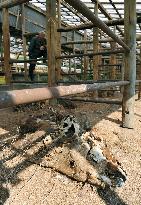
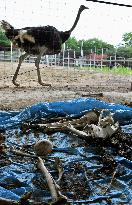
TOKYO, Japan - In this photo taken in the town of Okuma, Fukushima Prefecture, on May 20, 2012, an ostrich walks by the remains of another that starved to death after they were left abandoned at a breeding facility. In April 2011, the government designated Okuma and other municipalities within a 20-kilometer ring around the crippled Fukushima Daiichi nuclear power plant as a no-go zone. The plant's reactors suffered meltdowns after being struck by the March 11, 2011, earthquake and tsunami, spewing massive amounts of radioactive materials into the air and sea.

  •  
Abandoned animals in Fukushima

Abandoned animals in Fukushima

TOKYO, Japan - Photo taken in the town of Tomioka, Fukushima Prefecture, on May 21, 2012, shows dogs that have been abandoned by their owners. The town remains nearly deserted as the government in April 2011 designated it and other municipalities within a 20-kilometer ring around the crippled Fukushima Daiichi nuclear power plant as a no-go zone. The plant's reactors suffered meltdowns after being struck by the March 11, 2011, earthquake and tsunami, spewing massive amounts of radioactive materials into the air and sea.

  •  
Man caring for abandoned cattle in Fukushima

Man caring for abandoned cattle in Fukushima

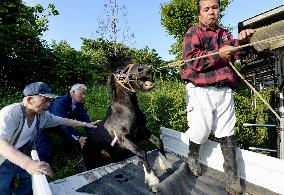
TOKYO, Japan - In this photo taken in the town of Tomioka, Fukushima Prefecture, on June 22, 2012, Naoto Matsumura (C) and his friend Kazuo Endo (R) help a pony onto a truck so he can take it home and care for it, doing so at the request of a resident (L) who has returned home temporarily. The town remains nearly deserted as the government in April 2011 designated it and other municipalities within a 20-kilometer ring around the crippled Fukushima Daiichi nuclear power plant as a no-go zone. The plant's reactors suffered meltdowns after being struck by the March 11, 2011, earthquake and tsunami, spewing massive amounts of radioactive materials into the air and sea.

  •  
Man caring for abandoned cattle in Fukushima

Man caring for abandoned cattle in Fukushima

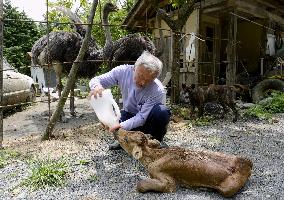
TOKYO, Japan - In this photo taken in the town of Tomioka, Fukushima Prefecture, on June 23, 2012, Naoto Matsumura, who cares for cattle abandoned by their owners, gives milk to a weakened calf via a feeding bottle. Behind him are the ostriches and the dog he keeps after their owners abandoned them. The town remains nearly deserted as the government in April 2011 designated it and other municipalities within a 20-kilometer ring around the crippled Fukushima Daiichi nuclear power plant as a no-go zone. The plant's reactors suffered meltdowns after being struck by the March 11, 2011, earthquake and tsunami, spewing massive amounts of radioactive materials into the air and sea.

  •  
Film director Morita dies

Film director Morita dies

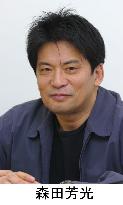
TOKYO, Japan - File photo taken in April 2006 shows Japanese film director Yoshimitsu Morita, who died of acute liver failure at a Tokyo hospital on Dec. 20, 2011. He was 61.

  •  
Japan to cull livestock in no-go zone near Fukushima plant

Japan to cull livestock in no-go zone near Fukushima plant

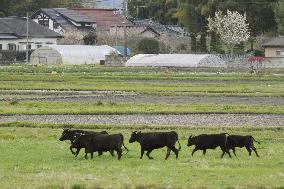
TOKYO, Japan - File photo taken on April 25, 2011, shows cows wandering without their owners within a designated no-entry zone in Namie, Fukushima Prefecture, near the crisis-hit Fukushima Daiichi nuclear plant. Japan has decided to cull livestock and poultry in the no-entry zone within a 20-kilometer radius of the nuclear power plant due to difficulty in feeding them, Chief Cabinet Secretary Yukio Edano said May 12, 2011.

  •  
Slogan promoting nuclear power near Fukushima plant

Slogan promoting nuclear power near Fukushima plant

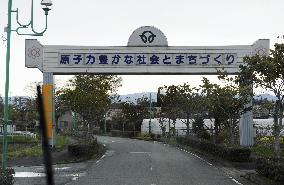
MINAMISOMA, Japan - Photo taken April 25, 2011, shows an empty street in the town of Futaba, Fukushima Prefecture, near the Fukushima Daiichi nuclear power plant, which has been crippled since the March 11 earthquake and tsunami. The government has restricted access to areas within a 20-kilometer radius of the plant. The slogan on the gate reads, ''Building an affluent town and society with nuclear power.''

  •  
Search for disaster victims in Futaba

Search for disaster victims in Futaba

MINAMISOMA, Japan - National Police Agency chief Takaharu Ando (L) salutes police officers engaged in search efforts for victims of the March 11 earthquake and tsunami in the town of Futaba in Fukushima Prefecture, near the Fukushima Daiichi nuclear power plant, on April 25, 2011. The government has set a no-entry zone covering areas within 20 kilometers of the plant, which has been crippled since the March 11 earthquake and tsunami.

  •  
Dog in deserted town near Fukushima plant

Dog in deserted town near Fukushima plant

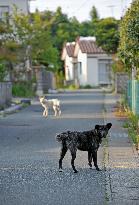
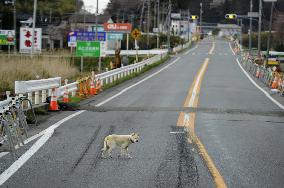
MINAMISOMA, Japan - A dog wearing a collar walks on an empty road in the town of Futaba, Fukushima Prefecture, on April 25, 2011, after the evacuation of residents due to the crisis at the Fukushima Daiichi nuclear power plant triggered by the March 11 earthquake and tsunami. The government has restricted access to areas within a 20-kilometer radius of the plant.

  •  
Search for disaster victims in Futaba

Search for disaster victims in Futaba

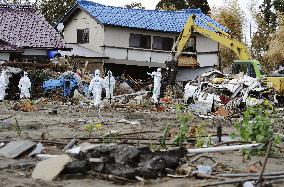
MINAMISOMA, Japan - Members of the Metropolitan Police Department search for victims of the March 11 earthquake and tsunami in the town of Futaba, around 4.5 kilometers from the crippled Fukushima Daiichi nuclear power plant, in Fukushima Prefecture on April 25, 2011. The government has restricted access to areas within a 20-km radius of the plant.

  •  
View of Fukushima Daiichi plant from Namie

View of Fukushima Daiichi plant from Namie

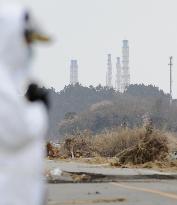
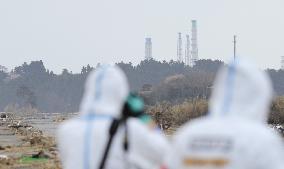
MINAMISOMA, Japan - Photo taken from the town of Namie, Fukushima Prefecture, on April 25, 2011, shows exhaust towers at the Fukushima Daiichi nuclear power plant crippled by the March 11 earthquake and tsunami. Part of the town beyond a 20-kilometer radius of the plant is subject to a government evacuation directive following the detection of radioactive materials, while the other part of the town within the radius has been designated as a no-entry zone.

  •  
View of Fukushima Daiichi plant 4.5 km away

View of Fukushima Daiichi plant 4.5 km away

MINAMISOMA, Japan - Photo taken from the town of Futaba, Fukushima Prefecture, on April 25, 2011, shows exhaust towers at the Fukushima Daiichi nuclear power plant, around 4.5 kilometers away, that has been crippled since the March 11 earthquake and tsunami. The government has restricted access to areas within a 20-km radius of the plant.

  •  
View of Fukushima Daiichi plant from Namie

View of Fukushima Daiichi plant from Namie

MINAMISOMA, Japan - Photo taken from the town of Namie, Fukushima Prefecture, on April 25, 2011, shows exhaust towers at the Fukushima Daiichi nuclear power plant crippled by the March 11 earthquake and tsunami. Part of the town beyond a 20-kilometer radius of the plant is subject to a government evacuation directive following the detection of radioactive materials, while the other part of the town within the radius has been designated as a no-entry zone.

  •  
Abandoned Fukushima livestock to be culled

Abandoned Fukushima livestock to be culled

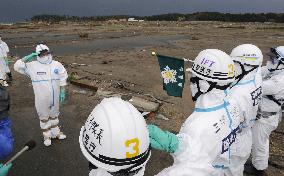
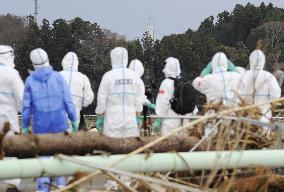
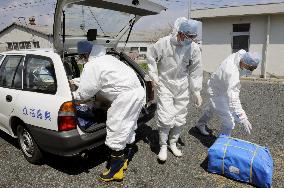
MINAMISOMA, Japan - Local officials in protective outfits prepare to enter the no-entry zone set by the central government, within the radius of 20 kilometers from the crippled Fukushima Daiichi nuclear power plant, in Minamisoma, Fukushima Prefecture, on April 25, 2011, to assess the conditions of the livestock and poultry there. The prefectural government has decided to cull animals and birds which are dying without food and water after evacuation of the residents.

  •  
Japan sets no-entry zone around Fukushima plant

Japan sets no-entry zone around Fukushima plant

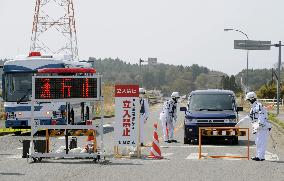
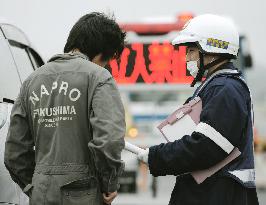
FUKUSHIMA, Japan - A police officer (R) explains to a driver about a no-entry zone set around the crippled Fukushima Nuclear Power Station on Route 6 in Minamisoma, Fukushima Prefecture, about 20 kilometers from the plant on April 22, 2011. The Japanese government imposed a no-entry zone within a 20-kilometer radius of the plant at midnight April 21 amid continued fears of radiation leaks.

  •  
Iitate added to evacuation zones

Iitate added to evacuation zones

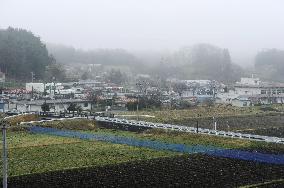
IITATE, Japan - The village of Iitate, Fukushima Prefecture, is added on April 22, 2011, along with some other municipalities outside a 20-kilometer radius of the crisis-hit Fukushima Daiichi nuclear power plant to the list of areas covered by the Japanese government's evacuation directive, due to concerns over high cumulative levels of radiation.

  •  
Soccer facility made base for work at Fukushima plant

Soccer facility made base for work at Fukushima plant

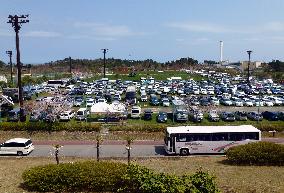
TOKYO, Japan - People walk into a hotel at the soccer training facility J Village in Fukushima Prefecture on April 21, 2011. J Village was made into a base of work to put the crippled Fukushima Daiichi nuclear power plant under control. The facility, approximately 20 kilometers south of the plant, was built in 1997 by the plant operator Tokyo Electric Power Co. at a cost of 13 billion yen and was donated to the prefecture.

  •  
Soccer facility made base for work at Fukushima plant

Soccer facility made base for work at Fukushima plant

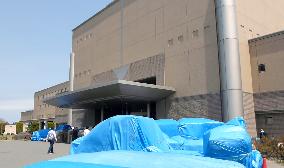
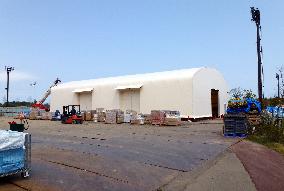
TOKYO, Japan - Photo taken on April 21, 2011, shows a supply storage set up at the soccer training facility J Village in Fukushima Prefecture, approximately 20 kilometers south of the crippled Fukushima Daiichi nuclear power plant. J Village was made into a base of work to put the crippled Fukushima Daiichi nuclear power plant under control. The facility was built in 1997 by the plant operator Tokyo Electric Power Co. at a cost of 13 billion yen and was donated to the prefecture.

  •  
Soccer facility made base for work at Fukushima plant

Soccer facility made base for work at Fukushima plant

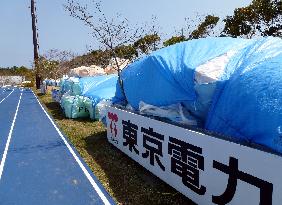
TOKYO, Japan - Photo taken on April 21, 2011, shows an artificial turf field of the soccer training facility J Village in Fukushima Prefecture which was turned into a waste depository. J Village was made into a base of work to put the crippled Fukushima Daiichi nuclear power plant under control. The facility, approximately 20 kilometers south of the plant, was built in 1997 by the plant operator Tokyo Electric Power Co. at a cost of 13 billion yen and was donated to the prefecture.

  •  
Soccer facility made base for work at Fukushima plant

Soccer facility made base for work at Fukushima plant

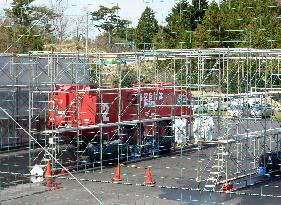
TOKYO, Japan - Photo taken on April 21, 2011, shows a radiation decontamination area for vehicles set up at the soccer training facility J Village in Fukushima Prefecture, approximately 20 kilometers south of the crippled Fukushima Daiichi nuclear power plant. The area which used to be part of a grass field is now a coated surface site as J Village was made into a base of work to put the plant under control. The facility was built in 1997 by the plant operator Tokyo Electric Power Co. at a cost of 13 billion yen and was donated to the prefecture.

  •  
Soccer facility made base for work at Fukushima plant

Soccer facility made base for work at Fukushima plant

TOKYO, Japan - Photo taken on April 21, 2011, shows a grass field at the soccer training facility J Village in Fukushima Prefecture. The field was turned into a parking area and heliport as J Village was made into a base of work to put the crippled Fukushima Daiichi nuclear power plant under control. The facility, approximately 20 kilometers south of the plant, was built in 1997 by the plant operator Tokyo Electric Power Co. at a cost of 13 billion yen and was donated to the prefecture.

  •  
Soccer facility made base for work at Fukushima plant

Soccer facility made base for work at Fukushima plant

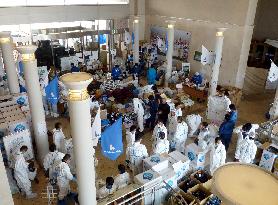
TOKYO, Japan - The lobby of a hotel in the soccer training facility J Village in Fukushima Prefecture is crowded with people who engage in work at the crippled Fukushima Daiichi nuclear power plant on April 21, 2011. The facility has been used as a base for work to put the plant under control. The facility, approximately 20 kilometers south of the plant, was built in 1997 by the plant operator Tokyo Electric Power Co. at a cost of 13 billion yen and was donated to the prefecture.

  •  
Japan sets no-entry zone around Fukushima plant

Japan sets no-entry zone around Fukushima plant

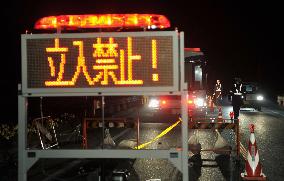
FUKUSHIMA, Japan - An ''off-limits'' warning shows on an electric signboard in photo taken at 12:03 a.m. on April 22, 2011, at a checkpoint in Minamisoma, Fukushima Prefecture, about 20 kilometers from the crippled Fukushima Daiichi nuclear power station. The Japanese government imposed a no-entry zone within a 20-kilometer radius of the plant at midnight April 21 amid continued fears of radiation leaks.

  •  
NY-based S. Korean groups donate for disaster victims in Japan

NY-based S. Korean groups donate for disaster victims in Japan

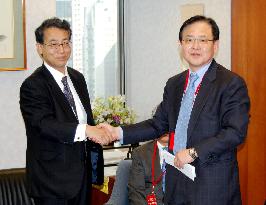
NEW YORK, United States - Consul General of South Korea Kim Young Mok (R) and Japanese Consul General Shigeyuki Hiroki shake hands as representatives of five New York-based South Korean groups handed over checks worth a total of $56,000 from donations to support disaster-stricken people in Japan at the Japanese Consulate General in New York on April 20, 2011.

  •  
Japan sets no-entry zone around Fukushima plant

Japan sets no-entry zone around Fukushima plant

MINAMISOMA, Japan - Resident's car waits at a checkpoint in Minamisoma, Fukushima Prefecture, on April 21, 2011, as they evacuate an area near the crippled Fukushima Daiichi nuclear power plant to Yamagata Prefecture. Japan's central government announced the same day it will enforce a no-entry zone of a 20-kilometer radius from the plant, effective at midnight.

  •  
Uehara against Twins

Uehara against Twins

BALTIMORE, United States - Baltimore Orioles reliever Koji Uehara throws the ball during the eighth inning of a game against the Minnesota Twins in Oriole Park at Camden Yards in Baltimore on April 20, 2011. Uehara allowed one run and two hits in the team's 5-4 win.

  •  
Japan PM Kan in Fukushima

Japan PM Kan in Fukushima

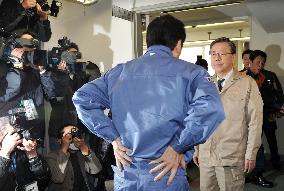
FUKUSHIMA, Japan - Fukushima Gov. Yuhei Sato (back, facing) receives Japanese Prime Minister Naoto Kan (front) at the Fukushima prefectural hall in Fukushima City on April 21, 2011. Kan told Sato of the government's setting of a no-entry zone within the 20-kilometer radius of the crippled Fukushima nuclear plant, prohibiting evacuees from temporarily returning home without government permission.

  •  
Ichiro 1-for-4 against Tigers

Ichiro 1-for-4 against Tigers

SEATTLE, United States - Seattle Mariners leadoff man Ichiro Suzuki hits a run-scoring single during the third inning of a game against the Detroit Tigers at Safeco Field in Seattle on April 20, 2011. Ichiro went 1-for-4 in the team's 2-3 loss.

  • Main
  • Top
  • Editorial
  • Creative
  • About Us
  • About ILG
  • Terms of use
  • Company
  • BEHIND
  • Price List
  • Single Plan
  • Monthly Plan
  • Services
  • Shooting
  • Rights Clearance
  • Support
  • FAQ
  • How To Buy
  • Contact Us
  • Become a Partner

© KYODO NEWS IMAGES INC

All Rights Reserved.

  • Editorial
  • Olympics
  • News
  • Sports
  • Japan
  • Tech
  • Royal
  • Disaster
  • NorthKorea
  • Old Japan
  • SNS
  • Creative
  • Food
  • Japan
  • Landscape
  • Animal
  • Popular
  • #Ukraine
  • #Thailand
  • #coronavirus
  • #N. Korea
  • #China
  • #Russia
  • #Ukraine
  • #Thailand
  • #coronavirus
  • #N. Korea
  • #China
  • #Russia
  • Food
  • Japan
  • Landscape
  • Animal
  • Olympics
  • News
  • Sports
  • Japan
  • Tech
  • Royal
  • Disaster
  • NorthKorea
  • Old Japan
  • SNS